If you’ve ever worked with Surge Protection Devices (SPDs) — whether as an electrical engineer, a facility manager, or someone specifying components for industrial or commercial systems — you’ve probably wondered how to get their surge current requirements right. Get this number wrong, and your SPD might either fail catastrophically during a surge, or be oversized to the point of unnecessary cost. As an SPD supplier who’s spent the last 12 years answering this exact question from clients across industries, I can tell you it’s not just a matter of pulling a number from a spec sheet. It’s a blend of system analysis, understanding surge origin, and matching your SPD to the environment it’s protecting. Surge Protection Device
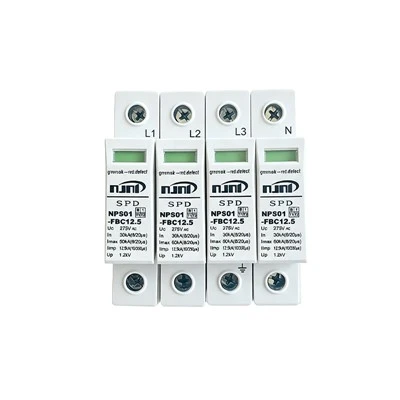
First, let’s ground this in what surge current actually is. A surge (or transient overvoltage) is a brief, sharp spike in voltage — typically between microseconds and milliseconds long — that comes from two main sources: internal and external. External surges are the big, high-energy ones: lightning striking power lines, utility switchgear operations, or even indirect lightning strikes that induce current into building wiring. Internal surges are smaller but far more frequent: motor starting, relay switching, inverter cycles, or even the discharge of large electrical loads within your facility. The required surge current for your SPD depends almost entirely on where that surge is coming from, and how much energy it’s carrying when it reaches your equipment.
Let’s start with the basics of calculation that even someone new to SPDs can follow, then dive into the nuances that trip up even experienced engineers. The core formula for required surge current (usually expressed in kiloamperes, kA) is rooted in the IEC 61643 series, the global standard for low-voltage SPDs, and NEC 285, which governs SPD installation in the United States. But before you plug numbers into any formula, you need to map your “surge path” — that is, where the surge originates, how it travels, and what it encounters along the way.
Take a commercial warehouse, for example. If your facility is within 1 kilometer of a lightning strike’s point of contact with the power grid, the surge arriving at your main service entrance will have a calculated current of up to 10 kA per phase, per IEC 61643-11. But that’s not the number you use for your SPD at the panel. Why? Because wires have inductance, which attenuates surge current as it travels. A 10-foot run of 4/0 copper wire attenuates a 10 kA surge by roughly 15%, dropping it to 8.5 kA, while a 50-foot run might cut that in half, to 5 kA. That’s why the first step is to measure the length of the wiring between your service entrance and the equipment you’re protecting — the longer the run, the lower the actual surge current that reaches your load.
Next, you need to account for “surge withstand” of your protected equipment. A 10-year-old office computer can only withstand a surge of around 1.5 kA before its power supply fails, while a 500-horsepower motor might need protection for surges up to 20 kA. That mismatch is where a lot of clients go wrong: they size their SPD for the maximum possible external surge, only to find it’s far more than their small equipment needs, leading to premature wear (SPDs degrade with every surge they absorb, so an oversized one will need replacement sooner). Or they size it for their equipment, only for a large lightning surge to bypass it and fry their gear.
Let’s break down the two most common calculation methods you’ll use as an SPD specifier: one for main service entrance SPDs, and one for downstream, equipment-level SPDs. For main service entrance SPDs (Type 1 or Type 2, per IEC), the formula is straightforward for direct or near-lightning events: I_req = (I_total * L_att) / F_factor, where I_total is the maximum surge current from the utility (typically 100 kA for a grid at 10 kV, per IEC), L_att is the attenuation factor based on wire length, and F_factor is the “coordination factor” to prevent SPD overlap. Most clients skip this factor, but it’s critical: if you install a Type 1 SPD at your service entrance, you don’t want a Type 2 downstream SPD taking on more current than it was designed for. The F_factor is usually 0.7 for commercial installations, meaning you size your downstream SPD for 70% of the main panel’s surge current.
For equipment-level SPDs (Type 3, for end-use devices), the calculation shifts to the energy the equipment can absorb, and the surge impedance of the load. A server rack, for example, has a surge impedance of around 50 ohms, so a 1 kV surge across that impedance will carry 20 A — but since surges are not DC, you convert that to kA for SPD sizing by dividing the peak voltage by twice the impedance for a 1.2/50 µs surge (the standard waveform for equipment-level transients). That gives you a rough baseline of 2.5 kA for a typical server, which matches the common 3 kA surge current rating for server power supply SPDs.
Now, let’s talk about real-world examples that we’ve walked through with clients over the years, because formulas only get you so far. Last year, we worked with a manufacturing plant in Ohio that was experiencing $150,000 worth of motor failures every time a summer thunderstorm rolled through. Their original SPD was rated for 5 kA, and they kept replacing it every 18 months, only to have the next motor take out a new one within a week. We did a site audit: the plant was 800 meters from a steel mill that had lightning strikes on a weekly basis, and their main service entrance wiring was 60 feet long, which meant the surge current arriving at their motors was 9.2 kA. Their original 5 kA SPD was too small, and it was absorbing every surge, degrading rapidly, while the motors had to take the brunt. We swapped them for 12 kA Type 2 SPDs at the main panel, and 8 kA Type 3 SPDs directly at each motor. In the 12 months since, they haven’t had a single motor failure. That’s a perfect example of how accurate surge current calculation prevented unnecessary costs and downtime.
Another common mistake: ignoring non-lightning surges. A few months back, a restaurant chain approached us after three of their walk-in freezers failed in a 6-month period, all traced to internal surges from their refrigeration compressors. Their SPD was rated for 6 kA, which was fine for lightning, but the internal surge from the compressor’s startup was only 2.2 kA — the problem was that their SPD’s response time was too slow. Wait, response time is part of surge current calculation, too? Absolutely. A surge has to be absorbed in less than 1 microsecond to prevent it from reaching sensitive equipment. If your SPD has a response time of 2 microseconds, it’s effectively too slow for surges smaller than its rated current. So in that case, we adjusted their calculation to account for response time, and sized their SPD for the compressor’s startup surge, not just the lightning surge. The result? No more freezer failures.
Let’s also clarify the difference between “nominal surge current” (I_nom) and “maximum surge current” (I_max), because this is where most clients get confused. I_nom is the amount of surge current the SPD can handle regularly — from the internal switching surges that happen 100 times a day in a facility. I_max is the maximum single surge current the SPD can absorb before failing. So when you’re calculating required surge current, you need two numbers: one for I_nom (to handle daily surges) and one for I_max (to handle the rare, high-energy surges like lightning). For the Ohio manufacturing plant, I_nom was 3 kA (for their internal compressor surges) and I_max was 12 kA (for lightning), which is why the 12 kA SPD worked — it handled both.
Now, if you’re not an electrical engineer, how do you get the numbers you need without doing complicated calculations? Here’s a practical, step-by-step guide we give to clients:
- Identify all surge sources in your space: external (lightning, utility) and internal (motors, inverters, relays). If you’re within 1 km of a lightning-prone area, prioritize the external surge.
- Measure the length of wiring between your service entrance and each critical piece of equipment. Use this to calculate surge attenuation: for every 10 feet of copper wire, subtract roughly 12% from the maximum utility surge current.
- Check the equipment’s spec sheet for its “surge withstand voltage” and “surge withstand current.” This is the maximum current the device can take before damage.
- Align your SPD’s I_nom and I_max to these numbers: I_max should be at least 20% higher than your equipment’s maximum surge withstand current, and I_nom should match your internal surge levels.
- Use industry standards as a baseline: Type 1 SPDs at main service entrances usually range from 10 kA to 50 kA I_max, Type 2 at sub-panels from 5 kA to 20 kA, and Type 3 at equipment from 1.5 kA to 10 kA.
Wait, but what about multi-phase systems? That’s another area where calculations can slip up. For three-phase systems, you’re dealing with line-to-line and line-to-neutral surges, so you have to calculate surge current for each phase pair separately. For example, a 480V three-phase commercial system has line-to-line surges up to 20 kA, so your SPD needs to handle that across both line-to-line and line-to-neutral paths. We see this mistake a lot: clients size their SPD for single-phase, 120V numbers, and it fails immediately when a three-phase surge hits.
Let’s address a common myth: “Higher kA rating means better SPD.” That’s only true if you need to handle a larger surge, but a higher kA SPD is more expensive, and if you don’t need it, it’s a waste of money. We’ve had clients install a 50 kA SPD for a small office with only 10 computers, and it was three times more expensive than a 5 kA model — and it ended up failing prematurely because it was absorbing small, daily surges that its larger clamping mechanism was never designed to handle. It’s not about the highest kA; it’s about the right kA for your specific environment.
Now, if you’re still unsure about your calculation, there’s no substitute for a site audit. As an SPD supplier, we offer free, no-obligation site assessments where we walk through your facility, map your surge paths, test existing wiring, and calculate the exact required surge current for your system. We’ve done this for everything from small retail stores to large manufacturing plants, and in 90% of cases, we find that clients have sized their SPDs either too small or too large, leading to avoidable downtime and replacement costs.
When you’re ready to move forward, remember that the right calculation is only the first step. SPD performance also depends on other factors: clamping voltage (how low it can bring the surge down), response time (how fast it kicks in), and durability (how many surges it can absorb before needing replacement). But without getting the surge current right, none of those other factors matter — a great SPD with an incorrect rating will still fail when a surge hits.

If you’ve been struggling to figure out the right surge current for your SPD, or if you’re seeing repeated equipment failures that you suspect are surge-related, we’re here to help. We can walk you through your system, provide a tailored calculation, and match you with the right SPD for your needs, no matter the size of your facility. Reach out to our team to discuss your requirements and get a personalized recommendation.
T1 50KA Surge Protective Device References
IEC 61643-11: Low-voltage surge protective devices – Part 11: Surge protective devices connected to low-voltage power systems – Requirements and test methods
National Electrical Code (NEC) Article 285: Surge Protection
IEEE C62.41.2: Guide on Surge Voltages in Low-Voltage AC Power Circuits
Nanjing Ningpu Lightning Protection Equipment Manufacturing Co., Ltd.
As one of the most professional surge protection device manufacturers and suppliers in China, we’re featured by quality products and good price. Please rest assured to buy customized surge protection device made in China here from our factory. Also, pricelist is available.
Address: Building 1, No.20 Shengyuan Road, Lishui Economic Development Zone, Nanjing City, Jiangsu Province, China
E-mail: xuhaiyan@npspd.com
WebSite: https://www.npspd.com/
